

Canaan earnings show Q1 revenue collapse as BTC and ETH treasury nears $148M



The latest Canaan earnings also revealed a new split screen among Bitcoin mining’s best-known hardware suppliers: the company selling mining machines reported a much weaker quarter just as its own crypto holdings became harder to ignore.
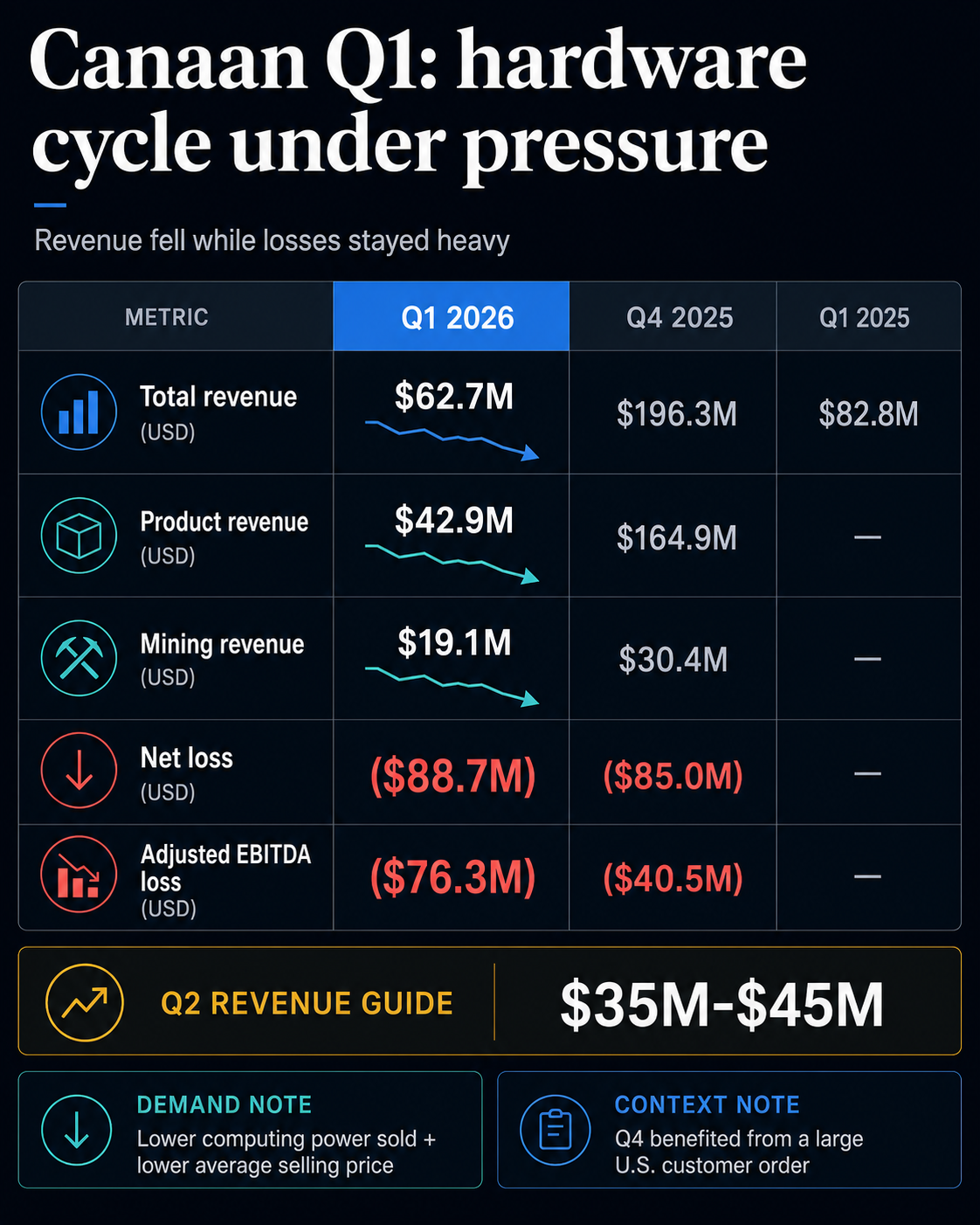
The ASIC maker said Q1 2026 revenue fell to $62.7 million, down from $196.3 million in the previous quarter and $82.8 million a year earlier.
Its net loss widened to $88.7 million from $85.0 million in Q4, while non-GAAP adjusted EBITDA loss almost doubled to $76.3 million from $40.5 million.
At the same time, Canaan ended March with 1,807.60 BTC and 3,951.53 ETH, a record crypto treasury for the company.

At CryptoSlate’s May 22 price levels of roughly $77,200 per BTC and $2,100 per ETH, that stack was worth about $148 million on a spot-market basis before accounting treatment, receivables, or liquidity constraints.
That is the tension inside the quarter. Canaan still sells the machines that power Bitcoin mining, but the reported numbers increasingly make it appear to be a company with a weaker hardware cycle on one side and a growing BTC-linked balance sheet on the other. The decline also reflected weaker demand for Bitcoin mining following tighter miner economics.
MetricQ1 2026ContextTotal revenue$62.7 millionDown from $196.3 million in Q4 2025Product revenue$42.9 millionDown from $164.9 million in Q4 2025Mining revenue$19.1 millionDown from $30.4 million in Q4 2025Net loss$88.7 millionWider than $85.0 million in Q4 2025Crypto treasury1,807.60 BTC and 3,951.53 ETHRecord level as of March 31, 2026Q2 revenue guide$35 million to $45 millionBelow Q1 revenue
The hardware cycle is the pressure point
Canaan’s product segment shows why hardware revenue, miner economics, and treasury exposure all have to be read together. ASIC miner sales fell to $42.9 million from $164.9 million in Q4 2025.
The company said the decline reflected lower computing power sold and a lower average selling price, which it tied to tighter market demand after Bitcoin’s price decline.

That phrasing matters because ASIC makers sit upstream from miner economics. When miners are confident that new machines can earn back their cost, hardware orders can pull revenue forward.
When power costs, difficulty, financing, or hashprice pressure compress margins, new hardware demand can weaken quickly.
Canaan’s Q1 comparison also had company-specific noise. Q4 benefited from a large U.S. customer order, which made the sequential decline look sharper.
But the demand language in the Q1 release still points to a broader problem: the hardware line reflected both weaker unit demand and lower average pricing.
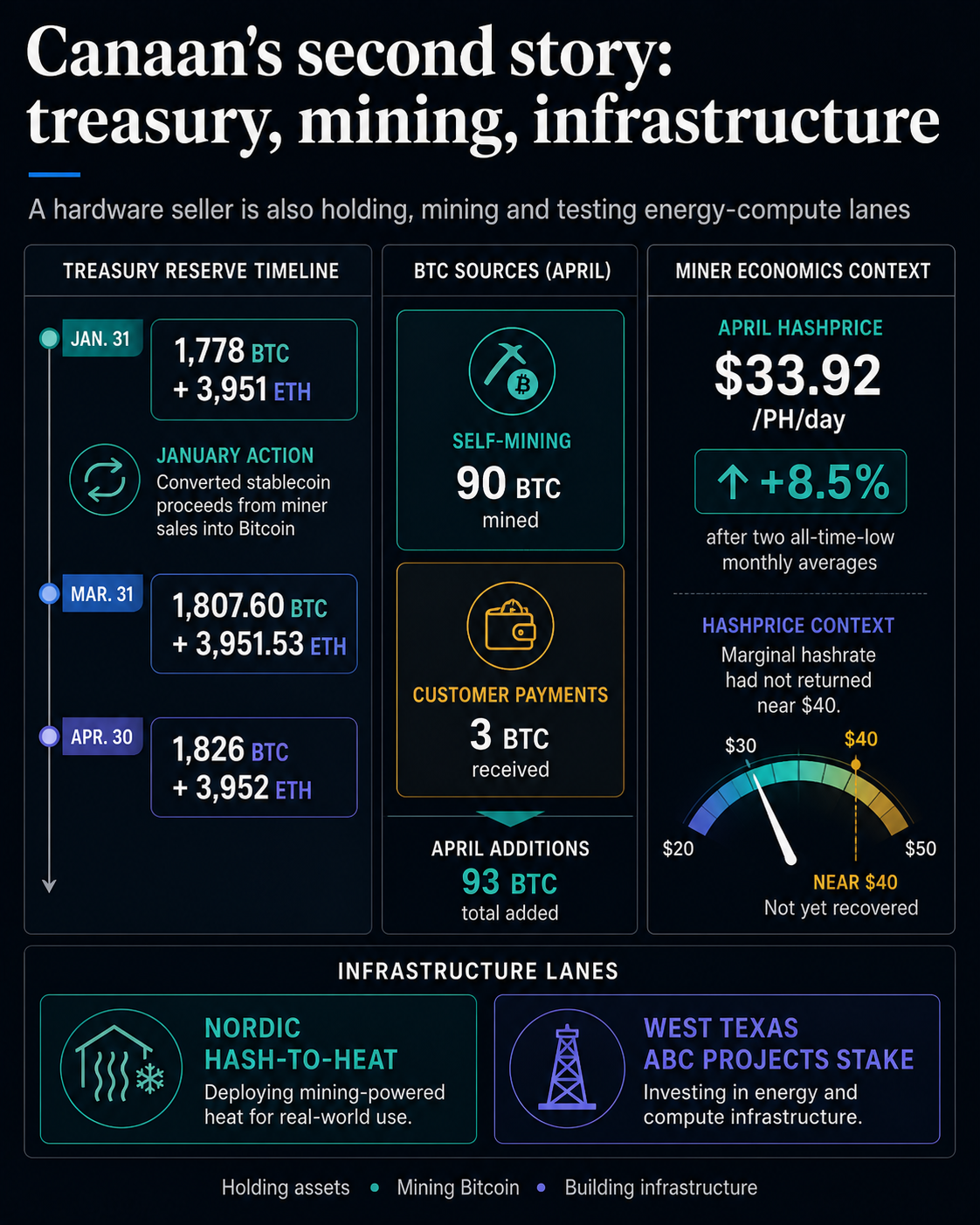
Outside Canaan, miner economics were still recovering from a difficult stretch. Hashrate Index’s April 2026 lookback said average USD hashprice rose 8.5% to $33.92 per PH per day after two all-time-low monthly averages.
Even with hashprice back near $40 in early May, the firm said marginal hashrate had not returned to the network.
CryptoSlate’s own mining coverage has tracked the same pressure from another angle. Earlier this year, miners did not rush machines back online after a price rebound, underscoring that spot BTC alone does not decide whether a rig is profitable.

Power price, difficulty, machine efficiency, and balance-sheet liquidity all matter.
For Canaan, that turns the product revenue line into the main signal. The company has two linked exposures: Bitcoin price moves and miners’ willingness to justify fresh capital spending on machines.
Q1 suggested that demand was not yet strong enough to absorb the hardware seller’s operating base.
The treasury is the counterweight
The other side of the story is that Canaan’s Bitcoin treasury and ETH holdings continued to rise.
The company’s January mining update said it had converted stablecoin proceeds from miner sales into Bitcoin, helping its reserve reach 1,778 BTC and 3,951 ETH at the end of that month.
By March 31, the Q1 results showed 1,807.60 BTC and 3,951.53 ETH. After the quarter closed, Canaan said its April operations added 90 BTC from self-mining and 3 BTC from customer payments, taking the balance to 1,826 BTC and 3,952 ETH by April 30.
That mechanism changes how the quarter reads. Canaan’s crypto balance now reflects ongoing operating decisions alongside its legacy holdings.
Some miner-sale proceeds have moved into Bitcoin, and self-mining continues to add BTC even as mining revenue fell from Q4.
The distinction is important. A pure ASIC supplier depends on customer demand for machines. A miner depends on operating efficiency, power costs, hashprice, and Bitcoin production.
A treasury holder depends on the market value of the assets it holds. Canaan now has elements of all three, which makes its reported weakness harder to interpret through a single lens.
The operating loss remains the counterpoint. The company reported an $88.7 million net loss in Q1 and guided Q2 revenue to only $35 million to $45 million, below the already weaker Q1 result.
That guidance means the balance sheet may become a larger part of the narrative precisely because the income statement is not yet showing recovery.
The roughly $148 million spot estimate for Canaan’s BTC and ETH also needs restraint. It is useful for scale, while market value differs from Canaan’s accounting value and investor motive remains unproven.
Without market-cap and share-price evidence, the more precise claim is that the treasury is now material enough to belong near the top of the story.
Infrastructure gives Canaan a third lane
Canaan’s Q1 release also pushed a broader infrastructure message. The company highlighted its Nordic hash-to-heat deployment and a stake in West Texas ABC Projects, which sits closer to energy and compute infrastructure than traditional machine sales.
Those details belong behind the core numbers, but they help explain why Canaan is looking beyond the next ASIC order cycle.
Public miners have already been pulled toward energy, hosting, and AI or high-performance compute strategies as mining margins tighten. CryptoSlate has covered how public miners are using treasuries and infrastructure pivots to navigate the post-halving market.

Canaan’s version is different because it is upstream. It sells into miners, operates its own mining exposure, holds a growing crypto stack, and is testing energy-linked infrastructure projects.
That mix can help the company if hardware demand remains weak, but it also makes the investment story more complicated. A buyer of Canaan’s stock is reading ASIC sales, Bitcoin price exposure, self-mining output, and management’s ability to turn infrastructure projects into durable revenue.
That complexity is why the quarter stops being a basic miss-versus-expectations story. Canaan’s customers are under stress, its product revenue fell sharply, and its own crypto balance became more prominent at the same time.
The seller of mining machines is becoming more exposed to the asset those machines are built to produce.
The next test is straightforward: whether Q2 revenue and product pricing stabilize enough to make Q1 look like a weak transition quarter, or whether Canaan’s guided decline pushes the story further toward treasury, self-mining, and infrastructure exposure.
If customer demand improves, Canaan can still be read primarily as a cyclical ASIC supplier with a growing BTC and ETH balance. If revenue follows guidance lower and the crypto stack keeps rising, the market will have more reason to treat the company as a hybrid: part hardware seller, part miner, part Bitcoin treasury, and part energy-compute operator.
For now, the sourced record supports the tension rather than a clean verdict. Q1 showed a weaker hardware business, a wider loss, lower mining revenue, and a larger crypto treasury.
That combination makes Canaan one of the clearer examples of how the Bitcoin mining trade is changing: even the company selling the picks and shovels is increasingly carrying the asset risk its customers face every day.
The company remains heavily exposed to Bitcoin mining hardware demand even as its treasury exposure grows. The broader question after these Canaan earnings is whether treasury growth can offset weaker hardware demand.