
Bitcoin’s next rally could trigger selling from holders of 874,000 BTC

Bitcoin faces a potential selling hurdle near $82,500, where Bitfinex estimates investors hold 874,000 BTC.
Data from CryptoSlate shows the cryptocurrency fell as low as $79,370 over the past 24 hours after losing its $81,300 support level. It later recovered to $80,102, though further gains could face selling from holders seeking to exit near their purchase prices.
The potential resistance comes as US spot Bitcoin ETF demand remains uneven following substantial withdrawals last week, raising questions about whether buyers can absorb the available supply ahead of Wednesday’s Federal Reserve interest-rate decision.
Bitcoin’s $82,500 resistance looms as ETF buying remains concentrated
According to Bitfinex’s Oct. 26 report, approximately 874,000 BTC was accumulated between $81,000 and $82,500, creating a substantial concentration of holdings above current market prices.

The exchange identified $81,300 as a critical price level that had supported Bitcoin for several weeks before the cryptocurrency closed below it on Oct. 22, 23, and 24.
That breakdown followed a failed recovery toward $84,930 and culminated in Bitcoin falling to $79,250 on Oct. 24, marking a 9.3% decline from its September high.
Bitfinex said the former support level has now become resistance, with investors who previously purchased Bitcoin around that range potentially using subsequent rallies to reduce their exposure.
The 874,000 BTC estimate reflects coins associated with the price range rather than confirmed sell orders. However, even a fraction of those holdings returning to the market could complicate recovery attempts if fresh buying remains limited.
The immediate concern is whether institutional demand can absorb that potential selling pressure.
Early signals from US spot Bitcoin ETFs remain mixed. The funds attracted $110.3 million in net inflows on Oct. 26, entirely driven by BlackRock’s iShares Bitcoin Trust (IBIT), while every other listed fund recorded zero net flows.
Monday’s inflows followed two consecutive withdrawal sessions totaling $773.5 million, suggesting ETF demand has yet to broadly recover.
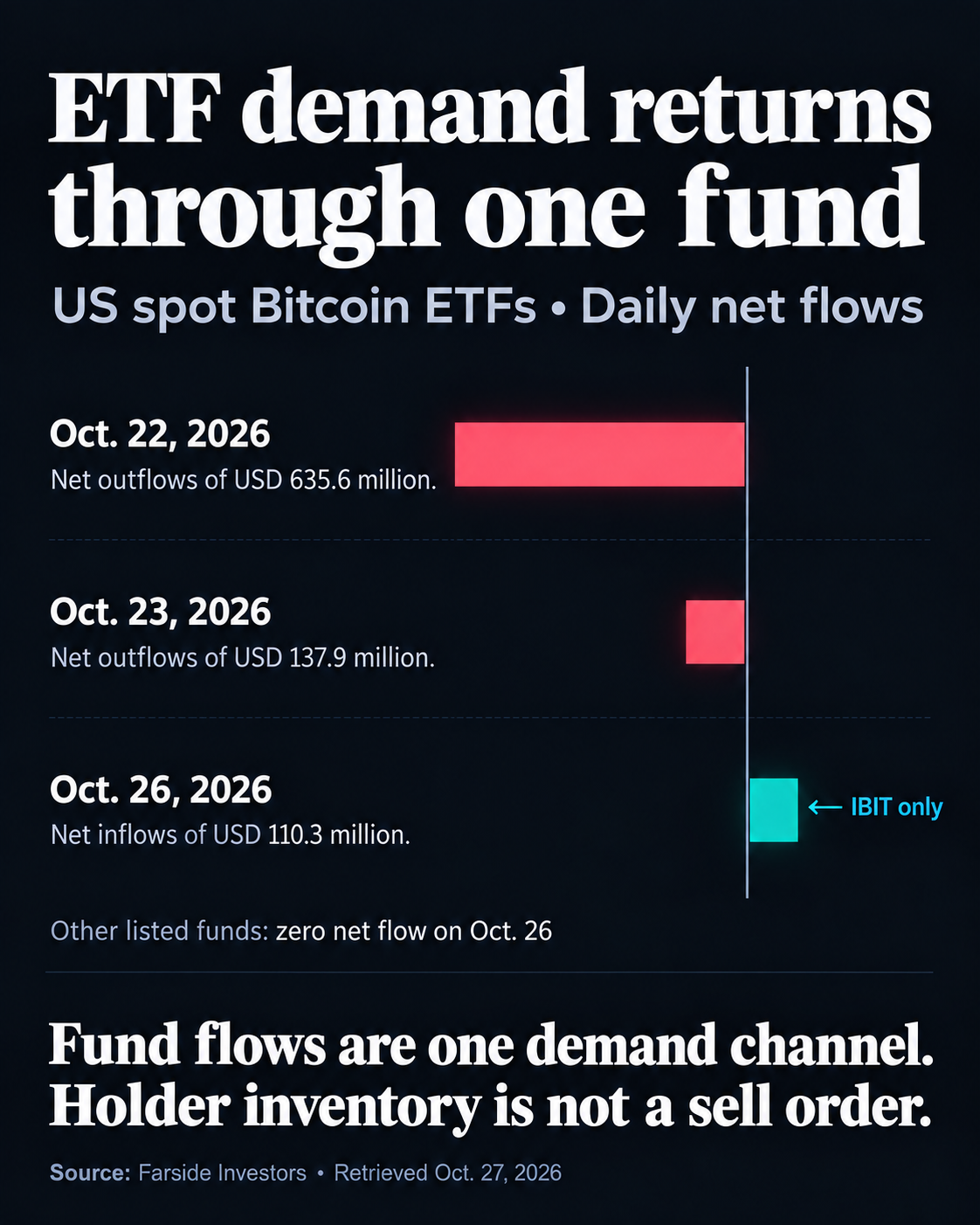
The three sessions left the ETFs with approximately $663 million in net outflows, underlining the challenge of sustaining a Bitcoin rebound without stronger buying demand.

Fed decision adds pressure to Bitcoin’s recovery attempt
The uncertainty surrounding Bitcoin’s recovery is compounded by increasing activity in derivatives markets.
Bitfinex reported that aggregate Bitcoin futures open interest increased from 645,411 BTC on Oct. 21 to 669,253 BTC on Oct. 25, even as the cryptocurrency declined.
The increase suggests outstanding futures positions grew during the sell-off, potentially amplifying volatility if a sharp price move triggers liquidations.
Bitfinex also identified liquidation concentrations around $82,300 to $83,000, creating conditions for a potential short squeeze if renewed buying pushes Bitcoin through the resistance area.
However, downside risks remain substantial.
The exchange identified another concentration of about 739,000 BTC accumulated between $77,500 and $80,000, which could provide support if the cryptocurrency sells off further.
A deeper decline would bring the $77,765 level into focus. That represents Bitcoin’s True Market Mean, an on-chain measure of the average acquisition price of economically active supply.
The immediate macroeconomic catalyst is the Federal Reserve’s Oct. 28 policy announcement, which could influence investors’ appetite for risk assets.
Bitfinex noted that traders had substantially reduced expectations for an October interest-rate increase, with the implied probability falling to 9.4% as of Oct. 25.
Its Oct. 25 snapshot also showed futures markets assigning a 72.1% probability to a December rate increase, suggesting expectations for tighter monetary policy had shifted toward the end of the year.
That positioning leaves Bitcoin sensitive to the Fed’s guidance, particularly if policymakers signal that borrowing costs could remain elevated or rise further.
Investors will receive additional economic signals on Oct. 29, when the US Bureau of Economic Analysis publishes its advance estimate of third-quarter GDP alongside September personal income and outlays data, including the Federal Reserve’s preferred PCE inflation measure.
Stronger-than-expected inflation could reinforce expectations of a December rate increase and weaken demand for risk assets. Softer readings, meanwhile, could reduce those expectations and encourage renewed buying across Bitcoin and other speculative markets.