
AI agents keep coming back for crypto as x402 wallet refill rate surges to 89%
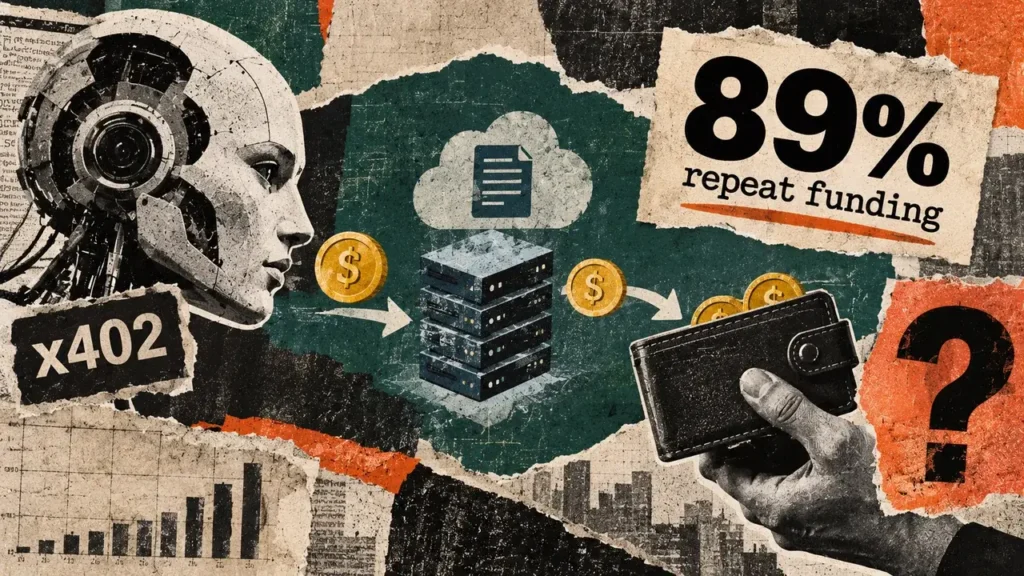
Two-thirds of newly funded x402 wallets made payments within an hour in the third quarter, signaling growing adoption of automated cryptocurrency transactions.
The proportion jumped from just 4% a year earlier, according to a new Chainalysis report. The median time between a wallet’s initial funding and its first payment also collapsed to 18 minutes from 73 days in late 2025, suggesting software developers are increasingly allocating funds for immediate transactions.
The findings mark a shift in the emerging market for machine-to-machine payments, where AI agents can purchase data, computing resources, and digital services using stablecoins. By July, Coinbase’s x402 standard on the Base blockchain had processed more than 138 million transactions as technology companies explored ways to monetize automated services.
AI agents move beyond experimental payments
Coinbase developed x402 in 2025, letting software applications pay for online resources directly through web requests and eliminating the need for users to manually authorize each purchase.

The technology lets AI agents request information or computing services, receive a payment instruction, and settle the transaction in cryptocurrency before accessing the requested resource.
Its appeal lies partly in the economics of micropayments, where conventional banking and card-processing charges can exceed the value of the underlying purchase.
Chainalysis found that more than 87% of x402 payments during the 16 months through September ranged between $0.0001 and $0.10, with transactions worth between one and 10 cents accounting for the most common payment size.
These small transactions increasingly support per-request services, including AI model inference, code reviews, financial intelligence, and data retrieval.
The model lets developers buy computing resources as needed, potentially opening new revenue streams for businesses that previously relied on subscriptions or enterprise contracts.
The shift is also becoming visible in how frequently wallets receive additional funding.
Of the x402 wallets that transacted on at least two separate days, Chainalysis found that 89.3% of those first funded in the second quarter of 2026 received another deposit within 30 days.
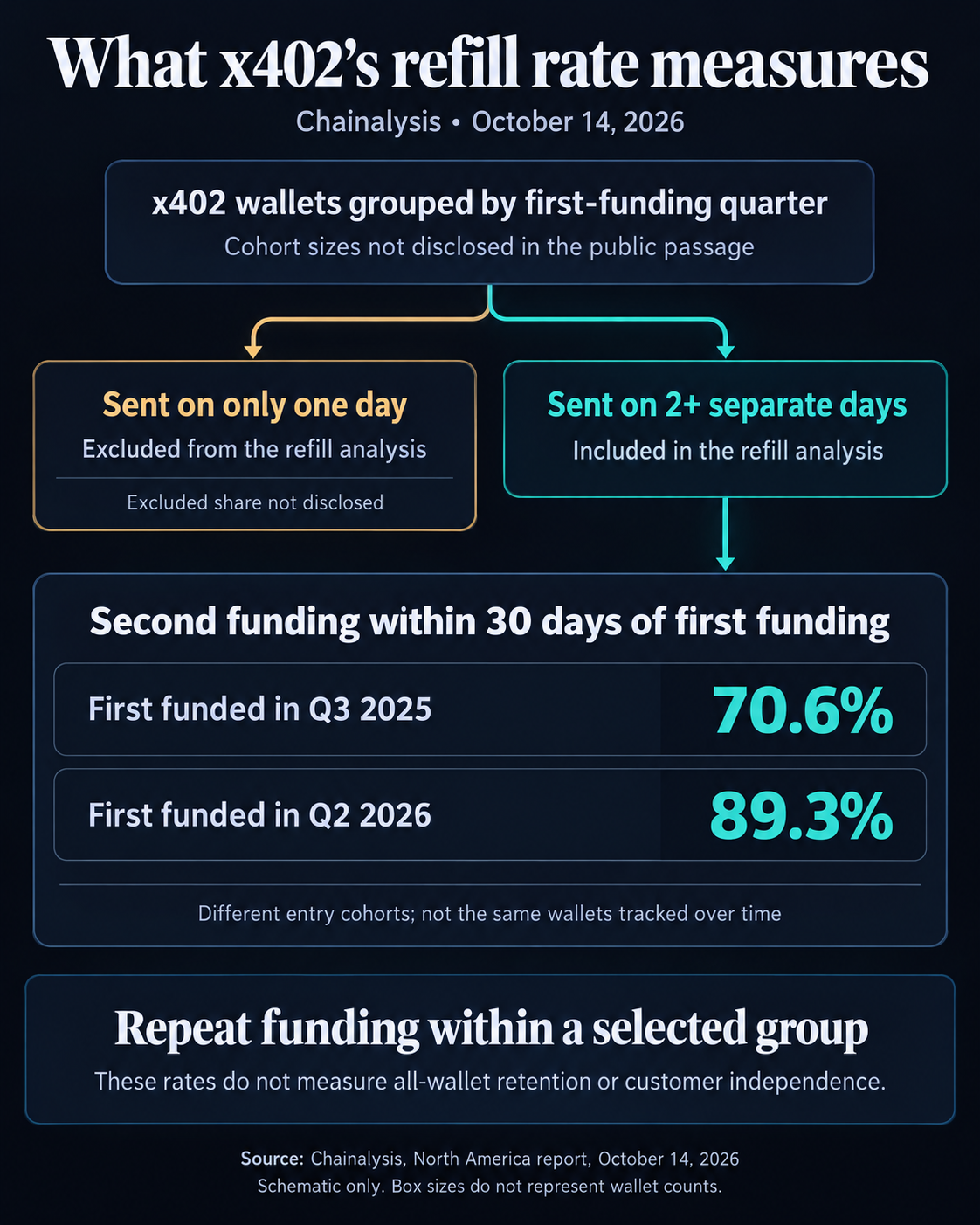
That compares with 70.6% for wallets first funded in the third quarter of 2025, pointing to more consistent financing among active participants.
The analytics firm attributed the increase to developers moving beyond one-time experiments and establishing recurring spending budgets for automated software.
Early x402 activity had been heavily influenced by speculative token launches and short-lived applications.
However, Chainalysis found millions of subsequent payments flowing toward information services and AI infrastructure, suggesting that demand is increasingly extending into software-related purchases.

AI model inference, which lets applications pay for responses generated by other AI systems, has become one of the protocol’s largest transaction categories.
US developers dominate emerging AI payment economy
American companies have emerged as the leading participants in this new market, reflecting their concentration of AI developers, stablecoin issuers, and cryptocurrency infrastructure providers.
Chainalysis estimates that US-attributed wallets account for approximately 30% of geographically identified transactions between AI agents and service providers.
Their dominance is particularly pronounced in AI model inference, where American-linked wallets generated 88.1% of payments.
US wallets also accounted for 41.8% of payments to agent frameworks and development tools, alongside 23.2% of transactions involving data and search services.
This concentration positions American infrastructure providers, including Coinbase and Circle, to benefit if machine-to-machine commerce becomes a meaningful market for dollar-denominated stablecoins.
BlackRock’s head of digital assets research, Will Su, told Chainalysis that the investment firm is closely monitoring the sector, with autonomous agents potentially generating continuous demand for small payments throughout the day.
China is showing a different activity pattern.
Chinese-linked wallets accounted for about 90% of geographically attributed payments for security and code-analysis services, much of which went to AgentLISA, a platform that uses AI to audit blockchain smart contracts.
However, Chinese wallets represented just 0.1% of identified AI model inference transactions.
Chainalysis suggested the difference may reflect Chinese developers’ greater reliance on open-weight AI models, including DeepSeek and Qwen, which can run without paying an external provider for every request.
That division could influence which companies capture revenue as automated software becomes a more active participant in digital commerce.
Growing transaction volumes face a commercial test
The rapid expansion of x402 has also raised questions about how much recorded activity represents spending between independent businesses.
A July academic study examining 136.7 million x402 settlements worth $44.1 million on Base found that 21.2% of transactions were fictitious, including self-payments and closed transaction loops.
Another 63.78% occurred within clusters of wallets linked through funding relationships, which can include transactions between related operators as well as legitimate commercial activity.
The researchers identified approximately $187,861 in payments reaching recognizable services without detected connections between buyers and sellers. Their broader estimate placed potentially genuine economic activity as high as $20.26 million.
Those findings highlight a commercial challenge for companies building around automated payments: translating rising transaction activity into revenue from customers purchasing services independently.
The economics are particularly demanding when individual transactions are worth fractions of a cent. Merchants must generate sufficient recurring purchases to cover computing, infrastructure, and operating costs, while payment providers need enough settlement activity to support their own businesses.
The July study found that 25,163 listed Base resources corresponded to 811 distinct payment recipients, with just 249 earning at least $10 during the observation period.
As more AI developers introduce pay-per-request services, growth in recurring merchant receipts will more clearly indicate which businesses can sustain themselves beyond the initial surge in automated payments.