

Michael Saylor says banks could ignite Bitcoin’s next rally as Strategy eyes $48 billion credit expansion

Michael Saylor expects bank lending and a new wave of BTC-backed credit products to drive Bitcoin’s next bull market.
Speaking at the Cantor Convergence conference, the Strategy chairman outlined how expanding access to financing could increase Bitcoin purchases, discourage existing holders from selling and attract institutional capital.
He said:
“Bank credit is going to be the key driver of additional buying and the key driver for the not selling.”
His outlook rests on two related developments: Strategy’s efforts to raise billions through digital-credit securities and growing interest among traditional banks in accepting Bitcoin-related investments as collateral.

Saylor expects both channels to strengthen demand for Bitcoin, although their ability to sustain purchases during market downturns remains uncertain.
Strategy outlines $48 billion in potential Bitcoin-backed credit expansion
Saylor said Strategy could significantly expand its Bitcoin accumulation program by issuing additional digital-credit instruments, building on a financing business he estimated had helped create a $16 billion market in 21 months.
He said:
“The company has right now the capacity to sell 48 billion of this stuff without Bitcoin price moving.”
Strategy’s model involves raising capital through preferred securities, including its STRC product, and using the proceeds to acquire Bitcoin. The company then pays dividends to investors while retaining exposure to potential appreciation in its Bitcoin holdings.
Saylor believes the structure could create a self-reinforcing cycle in which additional purchases push Bitcoin prices higher, strengthen Strategy’s balance sheet and attract further financing.
“But you can imagine if we sell $40 billion of credit and buy $30 billion of Bitcoin, the price is moving. The price is moving up,” he said.
Higher Bitcoin valuations could subsequently lower perceived credit risk, compress financing spreads and increase demand for Strategy’s securities, allowing the company to raise additional capital.
However, the strategy depends on investors continuing to purchase its credit instruments and the company maintaining sufficient resources to meet dividend obligations.
Saylor acknowledged those constraints elsewhere in his presentation, explaining that Strategy could adjust dividends, deploy dollar reserves, repurchase securities or sell Bitcoin when necessary.
He also said the company targets roughly 10.5% annual Bitcoin appreciation as the hurdle for capturing excess returns for common shareholders, while estimating that approximately 2% annual appreciation could sustain its dividend commitments under its financial model.
Those projections make the availability and cost of financing important variables in Strategy’s planned expansion.
Why Saylor sees bank lending lifting Bitcoin prices despite collateral risks
Beyond Strategy’s financing model, Saylor expects commercial banks to provide another source of Bitcoin demand by extending credit against investors’ existing holdings.
He compared the opportunity to the mortgage market, where access to financing allows buyers to purchase properties without paying their full value upfront.
Saylor specifically identified BlackRock’s iShares Bitcoin Trust (IBIT) as a potential beneficiary of broader lending arrangements involving JPMorgan, Morgan Stanley and Charles Schwab.
He explained:
“If Bitcoin flows into an ETF IBIT and if your bank JP Morgan or Morgan Stanley or Schwab will extend credit against the IBIT, you will tend to want to hold that asset. And of course, the better the credit terms they offer, the less incentive you have to sell, the more likely you are to buy.”
The arrangement could reduce selling pressure by allowing investors to access cash without liquidating their Bitcoin ETF positions. Lending products that permit investment purchases could also support additional demand.
Saylor pointed to Strategy’s proprietary banking adoption index, which he said had increased from 9% approximately three years ago to 34%. The index measures institutional activity across trading, custody, research, derivatives and lending, rather than the volume of Bitcoin-backed credit alone.
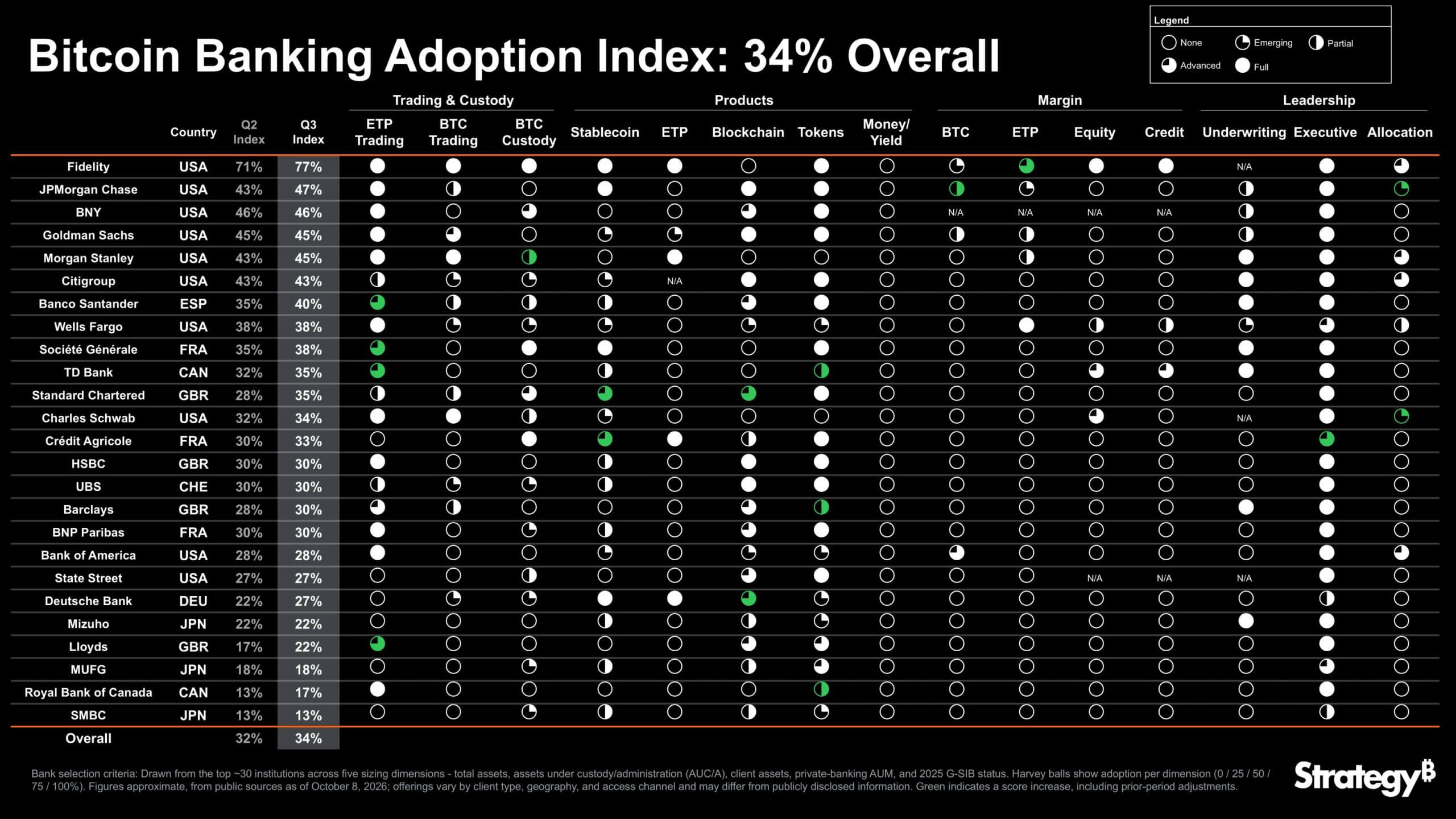
However, Charles Schwab’s existing Pledged Asset Line illustrates why borrowing against investments does not necessarily guarantee long-term holding power.
The facility allows qualifying investors to borrow against eligible securities without selling them, but its contractual terms give the bank considerable control over repayment.
Schwab can demand repayment at any time, increase collateral requirements without advance written notice and liquidate pledged securities when borrowers fail to satisfy their obligations.
If the bank demands repayment
If the bank demands repaymentDemand metDemand unmet
Other funds can meet the obligation. Illustrative paths; collateral may be sold before contact, with no guaranteed extra time.
Unmet obligations expose collateral to sale. Illustrative paths; collateral may be sold before contact, with no guaranteed extra time.
Other repayment resources can preserve holdings. An unmet demand can expose pledged securities to sale.
Disclosed rights and conditional paths, not reported liquidations. Specific Bitcoin ETF eligibility and advance rates are not established. PAL proceeds cannot purchase securities or spot cryptocurrency. Securities remain subject to lender approval and changing collateral requirements.
Consider a hypothetical investor borrowing $300,000 against $1 million in securities. A 40% decline in collateral value would increase the loan-to-value ratio from 30% to 50%. If the lender permitted borrowing up to 40% of collateral value, the investor would need to repay $60,000 or provide additional acceptable collateral.
Schwab further prohibits borrowers from using Pledged Asset Line proceeds to purchase securities or spot cryptocurrencies, meaning the product can help preserve existing investments but cannot directly finance additional Bitcoin purchases.
The bank has not established through these disclosures that IBIT qualifies for a particular collateral loan value.
Saylor nevertheless anticipates a credit expansion in 2027, supported by potentially easier monetary policy and greater institutional acceptance of digital assets.
His prediction ultimately depends on whether banks extend financing against Bitcoin-related holdings on terms that encourage additional investment while allowing borrowers to withstand market declines without forced selling.