

Wall Street wants 24/7 trading, but somebody has to bankroll the weekend
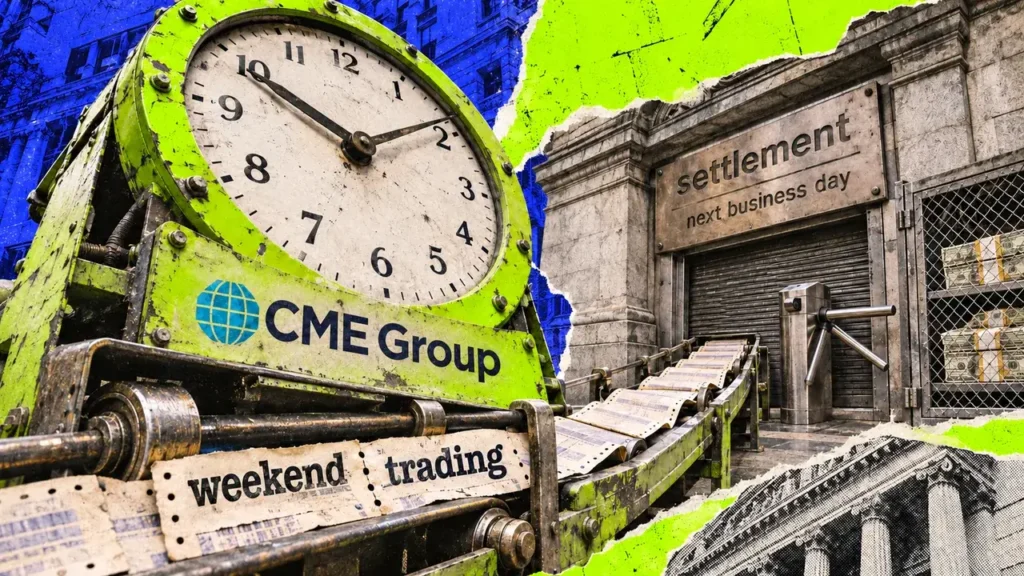
Wall Street’s move toward round-the-clock trading includes a key decision about who supplies cash when the main wholesale payment systems are closed.
If you want to adjust a position on Saturday, being able to trade saves you from waiting until Monday. The companies behind your trade still have to manage what they owe until they can settle, and they have to decide how much more business they can take on before they can replenish their cash or collateral.
CME opened its crypto derivatives markets on weekends in May, but kept settlement on a business-day schedule. Some stablecoin providers give customers faster access to cash by putting money at partner banks in advance.
Both arrangements give investors more hours to act, but they also mean different companies are now responsible for ensuring the money is available when needed.

We saw an example of what happens when the wait gets longer in June. Two major DTCC subsidiaries postponed a day’s securities settlement, leaving cash in the central counterparty’s account at the Fed and reducing the reserves available to banks.
The companies involved got through the delay without the jump in short-term rates that the Chicago Fed later described as a possible consequence. Longer trading hours ask companies to be ready for similar delays when their usual sources of cash and operational support may be harder to reach.
What an extra day of trading costs
When an institution buys and sells securities through DTCC’s clearing subsidiary NSCC, it can use what it’s owed on its sales to offset what it owes on its purchases. NSCC stands between buyers and sellers in eligible trades, which lets it work out what each company owes across all those transactions.
DTCC says that process, called multilateral netting, cuts equity payment obligations by an average of 98%. That reduces the amount companies have to pay at settlement.
NSCC netting cuts equity payments by 98% on average
Illustration per $100 of equity payment obligations before netting. DTCC reports a 98% average reduction. About $2 remains payable per $100, calculated as $100 minus $98.
 CryptoSlate
Companies still have to make the remaining payments once those trades are netted. According to DTCC’s June 30 incident notice, a participant submitted erroneous trades the previous day, creating an unusually large payment obligation.
DTC and NSCC invoked their market-disruption rules and got several extensions from the Federal Reserve while they tried to reverse the trades. They ran out of time at the final 8:30 p.m. deadline and carried the balances into June 30.
Settlement for both days went through on June 30, but the delay had already left companies with bills to cover. NSCC added a start-of-day charge to its risk fund to cover another day of trades it had guaranteed, and companies expecting payments had to wait for their money.
Cash had accumulated in the central counterparty’s account at the Fed, where it stayed until settlement could send it back to the banks due to receive it.
Banks’ balances at the Fed are called reserves. Some companies that clear and settle trades also have Fed accounts, and their balances are recorded separately.
Suppose banks send $10 billion to one of those companies and an operational problem holds up the payments back to them. All else equal, bank reserves fall by $10 billion, and the firm’s Fed balance rises by the same amount.
The cash is still at the Fed, but it’s in an account the banks can’t draw on to make payments.
The Chicago Fed described that in its November account of the disruption, but it didn’t put a dollar figure on the decline in reserves. Cindy Hull, a Chicago Fed official, offered two possible reasons short-term rates held steady: companies trusted the payments would go through, and the banking system had enough reserves to handle the temporary drop.
DTCC’s July 9 follow-up described who would bear some of the costs. Companies still owed money would receive interest based on what DTCC earned on the cash overnight, and those that owed money wouldn’t face financing charges.
DTCC would consider claims case by case when losses tied directly to the delay materially exceeded the interest payment.
The weekend is funded in advance
CME’s 24/7 schedule covers cryptocurrency futures and options, except spot-quoted futures, with at least two hours of weekly maintenance.
Under its implementation notice, trades made from Friday evening through Sunday evening are booked for the next business day, when clearing and settlement are processed. DTCC has made a similar move with NSCC trade processing, which has run 24 hours a day, five days a week since June 28.
CME assigns covered weekend crypto trades to the next business day, when it processes clearing and settlement.
This diagram covers CME’s published schedule for eligible contracts. The gap varies by trade time and holidays. The arrow shows sequence.
Your Bitcoin position can lose value over the weekend whether the futures exchange is open or closed. When the exchange is open, you can cut that exposure, and the companies clearing the trades must decide how much new risk customers can take before the next settlement.
Nodal set out two ways to do that for selected Coinbase derivatives in a May 2025 filing.
In the first option, members must keep additional weekend trading below half the customer’s excess margin, which is the collateral left over once existing requirements are met. In the second, customers can use all of that excess margin, minus any losses on positions they still hold.
Gains on those positions only count toward buying power once margin is recalculated after the weekend. Members that support weekend contracts also pay a surcharge into the guaranty fund. The idea is to keep customers from adding positions with money they’re still waiting to receive.
The Federal Reserve’s approved expansion will add Sundays and weekday holidays to Fedwire Funds and the National Settlement Service no earlier than 2028. The new schedule still runs Sunday through Friday, with daily hours of 22 and 21.5, respectively.
FedNow already runs through the weekend, but its transaction limit rose to $10 million in November 2025, well below what some clearing companies need to move.
Chicago Fed researcher David DeCarlo looked at CME’s quarterly disclosures from the third quarter of 2022 through the third quarter of 2025. Each quarter, CME’s base clearing service reported the largest payment any one participant had owed over the previous year. The median of those reported figures was $3.73 billion.
The median estimate under severe but plausible conditions was $24.31 billion. Both numbers cover a much broader business than weekend crypto trading, and some payments can be offset when companies use the same settlement bank.
While they’re not perfect representations of the market, they show why payment size can be as important as the hours the network is open.
How large CME’s biggest payment obligations can get
CME base clearing service. Medians of quarterly disclosures from Q3 2022 through Q3 2025. Actual figures are the largest single-participant payment obligation reported for the preceding year. Stress estimates reflect extreme but plausible conditions. The figures cover the broader clearing service and measure neither typical payments nor weekend crypto funding needs.
CryptoSlateFaster money still needs a balance sheet
You can send stablecoins that are already in circulation between wallets outside banking hours, provided the recipient can accept them. If they need dollars in a bank account, the next step is to redeem the tokens.
In an October explanation of its redemption service, Circle said qualified platform customers and customers using its payments network could redeem around the clock and receive money in near real time. Standard routes typically take up to two business days.
Circle says it can do that because it keeps cash ready at partner banks and has arrangements to move it when customers need it. The cash earns less than it would in Treasuries, so Circle gives up some interest to offer faster redemptions.
How well the service holds up when more customers than expected want their money depends on how much cash those banks can deliver.
Tokenized securities can also move outside banking hours once they’ve been converted into tokens. Already-tokenized securities can move at any hour between registered wallets on the same blockchain.
DTCC’s launch plan keeps conversion orders on business-day hours and puts digital cash and on-chain netting on an indicative roadmap for later. If you expect to post tokenized collateral over the weekend, you may need to prepare it in advance and confirm the recipient will accept it.
On Nov. 11, OKXICE, a joint venture between OKX and the owner of the New York Stock Exchange, announced a Nov. 23 launch for round-the-clock trading in more than 70 expected tokenized securities, including 59 Direxion ETFs.
Eligible US customers would trade through permissioned liquidity pools on X Layer, and the exchange would rely on a temporary SEC exemption. The launch announcement leaves open when the related banking and redemption services would be available.
When someone sends you an asset to settle a trade, you need to know when the transfer is final and whether you can use what you received.
International standards for systemically important stablecoin arrangements address both points. They cover when a transfer becomes legally irrevocable and whether a holder can redeem the stablecoin at face value under stress.
Now imagine a payment goes wrong at 3 a.m. on Saturday. The sender’s records show the payment instruction went through, but the recipient still has no money it can spend.
While staff work out whether the problem is a delayed message or a failed transfer, someone has to decide whether the company can spare cash for a replacement payment and what it can still afford to settle if the original payment goes through later.
The CFTC’s May 29 advisory on continuous trading explains what trading platforms should have in place under existing rules.
It covers who needs to be on hand across operations and risk, how companies respond to disruptions, whether they can reach the vendors they depend on, and how platforms can use parallel systems to upgrade or roll back software while keeping trading open.
When a payment gets stuck, the people who can authorize a replacement also need to reach the bank or counterparty that can deliver it.
The companies involved in June’s disruption got through an extra day without a jump in short-term rates. Weekend trading gives investors more ways to manage their exposure, and it forces companies to handle a delay like that while customers are still adding positions.
If an expected payment gets held up on Saturday, somebody needs enough cash to cover what comes due next, and the authority to release it before the usual payment systems reopen.